
Build methods and rates
A method is the shipping option offered to the customer. Its rate rows decide whether that option can serve the destination and what it costs.
Method settings
Each method belongs to one website or all websites and has its own code, title, active dates, tax mode and sort order. It also owns the package, conflict and attribute settings used during calculation.
The tax modes are:
- Auto follows Magento's shipping tax configuration.
- Net treats the configured rate as excluding tax.
- Gross converts the configured amount to a net shipping amount using the applicable shipping tax rate.
Rate matching
A rate can be limited by:
- country, including the
*option for all countries - postcode range or postcode pattern
- minimum and maximum weight
- minimum and maximum volume
- shipment or package calculation scope
- active date range
All configured bounds are inclusive. A specific-country row is considered before an all-country row when both match.
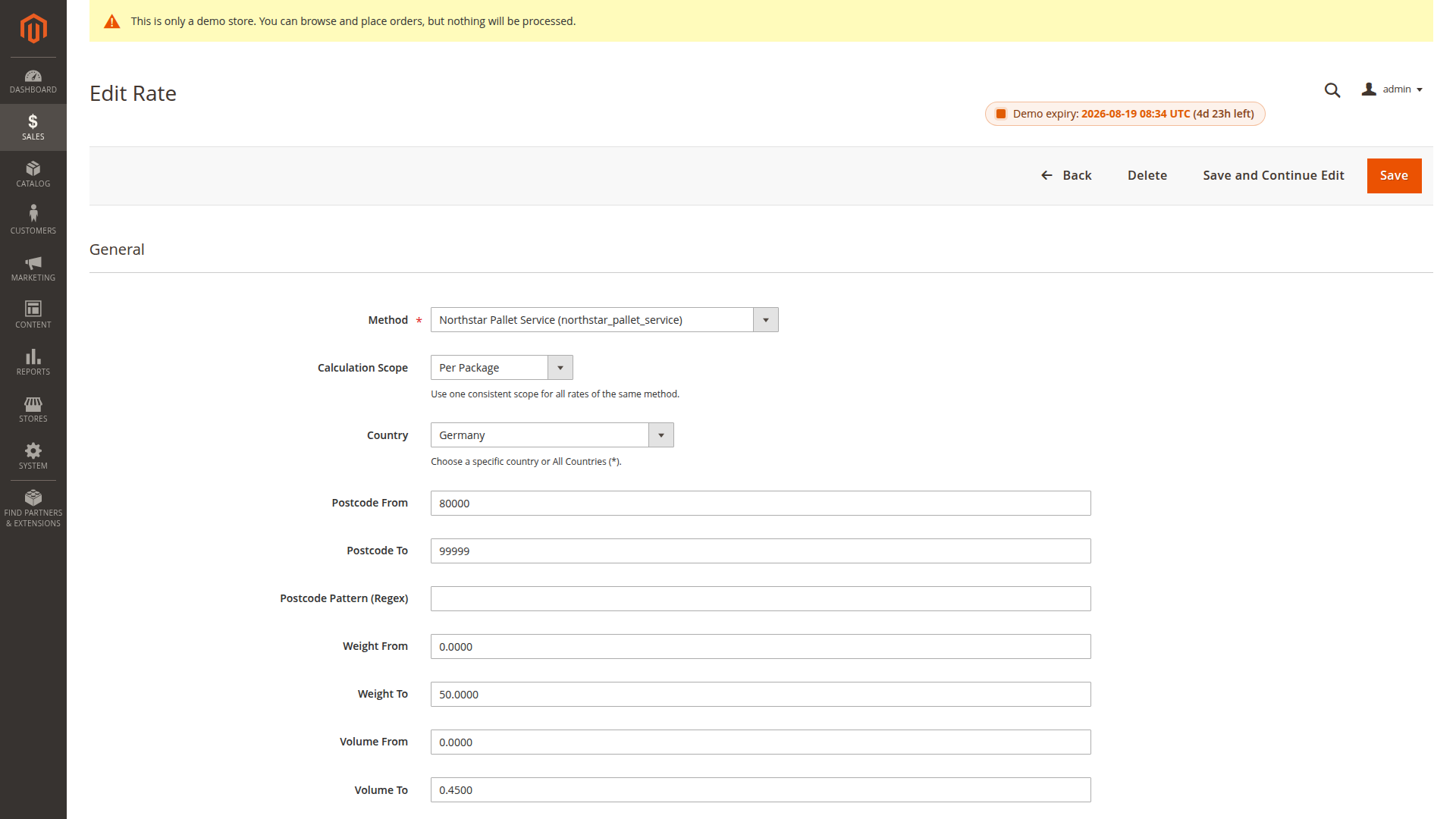
Postcodes
Use Postcode From and Postcode To for straightforward ranges. If both are empty, every postcode matches. A * endpoint also matches every postcode.
Use Postcode Pattern (Regex) only when a range cannot express the area. The pattern must match the full normalized postcode. For numeric ZIP+4 destinations, a value such as 12345-6789 is evaluated as 12345.
Keep patterns short and test them in the simulator. Unsafe constructs such as lookarounds and backreferences are rejected.
Price types
| Price type | Calculation |
|---|---|
| Fixed | Uses the entered amount once for the selected rate. |
| Per Weight Unit | Multiplies the amount by the relevant shipment or package weight. |
| Per Package | Multiplies the amount by the package count. In package scope, each package is evaluated separately. |
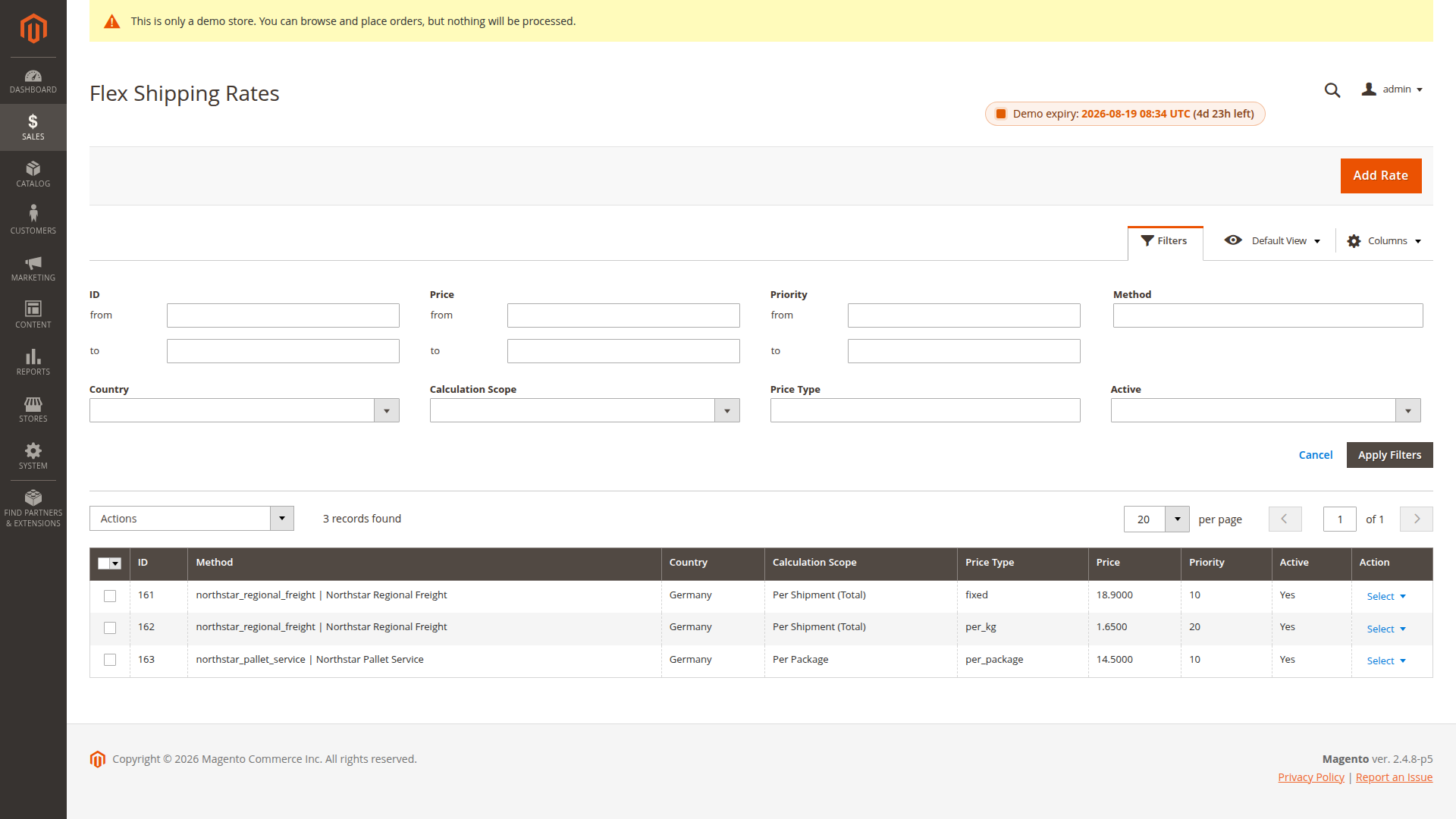
Overlapping rates
The method's conflict strategy decides which matching row wins:
- First Match uses the first row after country specificity, priority and ID ordering.
- Cheapest compares the calculated prices of all matching rows.
- Priority then Cheapest considers only the lowest priority number and chooses the cheapest row in that group.
- Custom uses the strategy selected in the Custom Conflict Fallback field directly below.
Use distinct bands where possible. Conflict strategies are useful for intentional overlaps, but they should not be the only way to understand a large matrix.
Method rules
Rules sit above the rate matrix. If a method has no active rules, it can proceed to rate matching. If it has active rules, at least one must match the shipping address.
Rules are checked by ascending priority. Stop Processing ends the rule loop after a match; it does not replace rate conflict handling.